

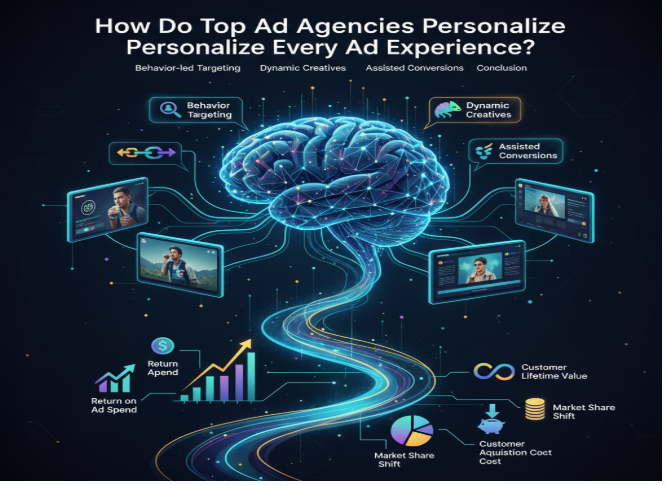
Let’s be real: in today’s digital noise, a generic ad is often an invisible ad. We’ve all scrolled past countless messages that feel utterly irrelevant, haven’t we? But then, every so often, an ad pops up that feels… uncanny. It’s almost as if it read your mind, knew what you were looking for, or understood a need you hadn’t even articulated yet.
That, my friends, is the magic of personalization, and it’s not just a nice-to-have; it’s a conversion powerhouse. When an ad speaks directly to an individual’s context, needs, and desires, it doesn’t just get noticed; it gets acted upon. The question then becomes, how do the best in the business pull this off consistently?
Behavior-led targeting
At the heart of truly personalized advertising is a deep, almost empathetic understanding of the consumer.
This isn’t about guesswork or broad demographic strokes; it’s about diving into the rich tapestry of online behavior. Think of it as consumer psychology meets data science.
The most effective campaigns aren’t just targeting “women aged 25-34”; they’re targeting “women aged 25-34 who recently browsed hiking gear, watched a video on sustainable travel, and have a history of purchasing eco-friendly products.”
This level of insight comes from meticulously tracking and analyzing user journeys across various touchpoints. It’s about understanding what pages they’ve visited, what products they’ve viewed (and for how long), what searches they’ve performed, and even what content they’ve engaged with on social media. This data, when ethically gathered and intelligently processed, paints a remarkably clear picture of intent and interest.
The real skill lies in segmenting these audiences with precision. It’s not just about collecting data, but about drawing meaningful connections.
For instance, someone who abandoned a shopping cart might receive a different ad than someone who just viewed a product page for the first time.
The former might get a reminder ad with a small incentive, while the latter might see an ad highlighting key product benefits or social proof.
This nuanced approach is what sets the top ad agencies apart. They’re not just casting a wide net; they’re using a finely woven one, tailored to catch specific fish.
Many top digital marketing agencies also leverage predictive analytics, using past behavior to anticipate future needs. If a user consistently researches home improvement projects, even without directly searching for a specific product, an agency might infer they’re in the market for related items.
This proactive approach allows brands to be present and relevant even before the consumer explicitly states their need, creating a much more seamless and helpful experience.
As platforms like HubSpot consistently highlight, understanding the customer journey is paramount to delivering relevant experiences that build loyalty.
Dynamic creatives
Once you know *who* you’re talking to and *what* they’re likely interested in, the next crucial step is to deliver an ad that actually reflects that understanding. This is where dynamic creatives come into play. Gone are the days of creating one ad and blasting it to everyone. Dynamic creative optimization (DCO) allows for elements within an ad – the headline, image, call to action, product recommendations, even the background color – to change in real-time based on the individual viewer’s data.
Imagine this: you’ve been browsing for a specific pair of running shoes on an e-commerce site. Later, you see an ad for that *exact* shoe, in *your size*, perhaps even with a complementary product like running socks. That’s not a coincidence; that’s dynamic creative in action. The ad components are assembled on the fly, pulling from a vast library of assets to create the most relevant combination for you. This isn’t just about showing the right product; it’s about crafting the right message.
If a user has shown interest in the sustainability aspect of a brand, the ad’s headline might emphasize eco-friendliness. If another user prioritizes price, the ad might highlight a discount or value proposition. This level of granular customization ensures that every impression feels less like an interruption and more like a helpful suggestion. The technology behind this is sophisticated, often involving AI and machine learning algorithms that constantly test and learn which creative combinations perform best for different audience segments.
It’s an iterative process where every interaction provides valuable data, leading to even more refined personalization. This continuous optimization loop is a hallmark of how the top ad agencies maintain their edge, delivering campaigns that are not only personalized but also incredibly efficient and effective. Think with Google often emphasizes the power of machine learning in adapting ad experiences to individual users, pushing the boundaries of what’s possible in digital advertising.

Key Takeaways
- Personalization is crucial for lifting conversions, moving beyond generic messaging to speak directly to individual needs and contexts.
- Behavior-led targeting relies on deep data analysis of user journeys to understand intent and segment audiences precisely.
- Dynamic creatives use technology like AI and DCO to assemble ad elements in real-time, tailoring headlines, images, and calls to action to individual viewers.
- Ethical data gathering and consumer psychology are foundational to creating relevant and trustworthy personalized ad experiences.
- The process is iterative, with continuous testing and optimization driving increasingly effective and efficient campaigns.
Conclusion
The future of advertising isn’t just about reaching more people; it’s about reaching the right people, with the right message, at the right moment. Personalization, driven by insightful behavior-led targeting and executed through dynamic creatives, transforms advertising from a broadcast into a conversation. It’s a complex endeavor, requiring a blend of data science, creative finesse, and a genuine understanding of human psychology, but the payoff in engagement, relevance, and ultimately, conversion, is undeniable. As technology continues to evolve, expect these personalized experiences to become even more seamless, intuitive, and integral to how brands connect with their audiences.